Reading the scene between Maire and Yolland made me think of the story line in the movie Love, Actually, that follows Jamie (a British writer) and Aurelia (a Portugese house keeper). They don't speak a common language but develop a love over the course of the movie. They use pantomime and gestures to communicate but through something that goes beyond words, they are drawn to each other and fall in love.
When Jamie returns to England for the holidays, he learns Portuguese while Aurelia learns English (not knowing what the other was doing). He ends up proposing to her in broken Portuguese---
This may be a sappy, romantic, unrealistic story, but I love it- it's my favorite plot in the movie. And although communication is important to any relationship, I feel that just being in the same room with someone, just being quiet together is a time for bonding- you become comfortable with that person.
I'd like to believe that if Maire and Yolland could have lived happily ever after, they would have learned each other's languages and been able to communicate beyond place names.
Showing posts with label portfolio. Show all posts
Showing posts with label portfolio. Show all posts
Thursday, April 30, 2009

Thursday, April 23, 2009
The spoken word
Tonight, I read the first act of Brian Friel's Translations. So did my fiance. We read it aloud by splitting up the roles, although at times we were talking to ourselves (like when Daniel was reading for Manus and Jimmy). It really made a difference in my understanding of the play. I had started reading it by myself but the scenes came to life when we were reading it out loud, putting in the inflections and stumbling over the Gaelic and Latin. Our translation was definitely an interesting one.
As the story progressed and Owen explained how the English would be renaming some areas and towns to make it "easier," I was reminded of a scene from P.S. I love you. Here's the clip- it's a terrible version of it, since someone was recording it in a movie theatre, but it's all I've got. About a minute and a half in, Holly (Hillary Swank) struggles with the name of an Irish town- a prime example of how things can get lost in translation!
As the story progressed and Owen explained how the English would be renaming some areas and towns to make it "easier," I was reminded of a scene from P.S. I love you. Here's the clip- it's a terrible version of it, since someone was recording it in a movie theatre, but it's all I've got. About a minute and a half in, Holly (Hillary Swank) struggles with the name of an Irish town- a prime example of how things can get lost in translation!
Wednesday, April 15, 2009
Believing and Knowing
"All it takes is faith and trust..." (and a little bit of pixie dust)- Disney's Peter Pan
Faith and trust, belief and knowing. The similarities are many and the differences subtle. It was very interesting to discuss belief and knowing in class on Tuesday. It's a big concept to wrap your mind around and I'm still working on it. These are my thoughts:
I know I am a female homo sapien. But that is because I have faith in the people who decided that it was the proper name for the species and gender I belong to.
I also know that Jesus Christ is my Savior. But it is not because I have faith in the "fact based" historians or the Discovery Channel specials, I have faith in Him, in God, in the comfort that comes with the whole set of beliefs that the Catholic Church has passed on.
"Believing" tends to connote that there is something "assumed," that someone or something has persuaded you to have faith in a certain "truth." Beliefs often shift, grow, disappear, and continuously change.
I don't think knowing and believing are completely separate things. Knowledge can help clarify beliefs just as belief can be the driving factor to find knowledge in a certain area of your life.
Faith and trust, belief and knowing. The similarities are many and the differences subtle. It was very interesting to discuss belief and knowing in class on Tuesday. It's a big concept to wrap your mind around and I'm still working on it. These are my thoughts:
I know I am a female homo sapien. But that is because I have faith in the people who decided that it was the proper name for the species and gender I belong to.
I also know that Jesus Christ is my Savior. But it is not because I have faith in the "fact based" historians or the Discovery Channel specials, I have faith in Him, in God, in the comfort that comes with the whole set of beliefs that the Catholic Church has passed on.
"Believing" tends to connote that there is something "assumed," that someone or something has persuaded you to have faith in a certain "truth." Beliefs often shift, grow, disappear, and continuously change.
I don't think knowing and believing are completely separate things. Knowledge can help clarify beliefs just as belief can be the driving factor to find knowledge in a certain area of your life.
Thursday, April 2, 2009
What's in a name?
The main character in the novel Lucy was given the name "Lucy Josephine Potter." For each part, she had some kind of explanation- Josephine was for a rich uncle who ended up penniless, Potter most likely had its roots in an English family who once owned her ancestors as slaves and Lucy had a very special origin. As Lucy retells the story, she claims that her mother said, "I named you after Satan himself. Lucy, short for Lucifer. What a botheration from the moment you were conceived." (page 152)
I find that explanation interesting, heartbreaking and a bit ironic. The name "Lucy" is of Latin origin and means "light," something which is the exact opposite of the images evoked at the mention of Satan. Saint Lucy is the patroness of sight. I think the character Lucy was properly named- through her coming of age throughout the novel, she sheds light upon many things: her desire for independence, the truth about Mariah, Lewis, Peggy and Paul. She is able to see things clearly as they are, without trying to disguise the truth.
Interested in what your name means? Go to www.name-meanings.com to find out!
I find that explanation interesting, heartbreaking and a bit ironic. The name "Lucy" is of Latin origin and means "light," something which is the exact opposite of the images evoked at the mention of Satan. Saint Lucy is the patroness of sight. I think the character Lucy was properly named- through her coming of age throughout the novel, she sheds light upon many things: her desire for independence, the truth about Mariah, Lewis, Peggy and Paul. She is able to see things clearly as they are, without trying to disguise the truth.
Interested in what your name means? Go to www.name-meanings.com to find out!
Thursday, March 19, 2009
Knickknacks or rubbish?
After reading "Interpreter of Maladies" by Jhumpa Lahiri, I am reminded of all the little knickknacks that have collected over the years on shelves, in drawers, and under my bed that would serve as clues to the person I am. For instance, my square piece of "wall" from my junior year musical signed by my fellow cast mates and the "Break a Leg" teddy bear key chain that I had received from a teacher for a performance of that show. Along with that are miscellaneous others like a tiny 3-D manger scene, a ballerina figurine, a "ring box" which actually contains a wooden ladybug- these all speak to pieces of me and moments in my past. I could tell you stories about each of the objects aforementioned, but I won't get into that here. And though they all have these back stories, they really don't serve any purpose but to be displayed somewhere. When it's all said and done, these are things that will most likely be tossed during spring cleaning or when I finally move out of my parents' house this summer, but I am wondering to myself now- why did I keep them so long in the first place?
Do you have a lot of knickknacks or are you a minimalist? Would you be a Twinkle or a Sanjeev if you were to come across another person's abandoned mementos? I'd be a Sanjeev, though I'd have a little more compassion and understanding- I definitely wouldn't take a hammer to a Buddha statue but I wouldn't put him on my mantle either.
Do you have a lot of knickknacks or are you a minimalist? Would you be a Twinkle or a Sanjeev if you were to come across another person's abandoned mementos? I'd be a Sanjeev, though I'd have a little more compassion and understanding- I definitely wouldn't take a hammer to a Buddha statue but I wouldn't put him on my mantle either.
Thursday, March 5, 2009
Is it OK to shake up Shakespeare?
If someone were to ask me to name my favorite playwright, I would say Oscar Wilde in a heartbeat. But if that same person were to ask for one of my favorite movies, I'd just as quickly same "10 Things I Hate About You"... and since I watch movies more frequently than I go to the theater, should I give Shakespeare some credit for one of my top ten movies?
There is no doubt that Shakespeare is one of the most influential writers who transcends hundreds of years and is still studied in classrooms worldwide. However, I am not one to cozy up with one of his plays for a long read unless it is for a class- it's just not my style. (More power to those of you who do this!) But I love his stories and the many adaptations of them- like "10 Things I Hate About You" and the musical, "Kiss Me, Kate." For me, it has more to do with the kind of characters and the way they develop over the course of events and less to do with the use of iambic pentameter and rhyme. Unlike this number from "Kiss Me, Kate" suggests, not all girls would be impressed with a guy who brushed up his Shakespeare...
What do you think? Do you feel like modern day adaptations do justice to the timeless work of Shakespeare or not? Do you prefer the classic performances as they looked in his time or the modern performances which take liberties with altering the script?
There is no doubt that Shakespeare is one of the most influential writers who transcends hundreds of years and is still studied in classrooms worldwide. However, I am not one to cozy up with one of his plays for a long read unless it is for a class- it's just not my style. (More power to those of you who do this!) But I love his stories and the many adaptations of them- like "10 Things I Hate About You" and the musical, "Kiss Me, Kate." For me, it has more to do with the kind of characters and the way they develop over the course of events and less to do with the use of iambic pentameter and rhyme. Unlike this number from "Kiss Me, Kate" suggests, not all girls would be impressed with a guy who brushed up his Shakespeare...
What do you think? Do you feel like modern day adaptations do justice to the timeless work of Shakespeare or not? Do you prefer the classic performances as they looked in his time or the modern performances which take liberties with altering the script?
Thursday, February 19, 2009
Ocular proof
In Othello, its title character says he needs "ocular proof" to be convinced of his wife's unfaithfulness. The "seeing is believing" attitude is a dangerous one and brings up issues my photography class has discussed. One photographer, Annette Kuhn, writes that photographs can be reduced to a compilation of light and dark patches when inspected closely, thus offering no true proof of anything. The value of a photograph is what it represents, but in this age of PhotoShop, what images can be trusted?

The problem with other "ocular proof" like seeing Desdemona and Cassio speaking together or Cassio with the handkerchief is that Othello saw what Iago wanted him to see. Being a trusting individual, without Iago's prompting, Othello might have seen Desdemona's kindness in consoling Cassio. And the handkerchief was also due to Iago's plotting. Looking at things through a particular lens, such as through Iago's twisted perspective or as an audience member, one sees different things as "truth." The audience has the advantage of seeing everything while poor Othello is led by Iago to his ultimate demise by relying on his slant of the events. Ocular proof can't stand by itself- it is often unreliable and misleading which causes people to jump to conclusions, especially when outside influences are present.
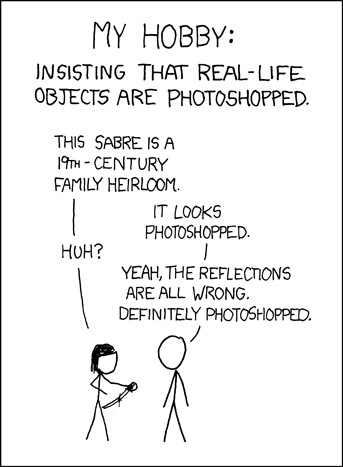
The problem with other "ocular proof" like seeing Desdemona and Cassio speaking together or Cassio with the handkerchief is that Othello saw what Iago wanted him to see. Being a trusting individual, without Iago's prompting, Othello might have seen Desdemona's kindness in consoling Cassio. And the handkerchief was also due to Iago's plotting. Looking at things through a particular lens, such as through Iago's twisted perspective or as an audience member, one sees different things as "truth." The audience has the advantage of seeing everything while poor Othello is led by Iago to his ultimate demise by relying on his slant of the events. Ocular proof can't stand by itself- it is often unreliable and misleading which causes people to jump to conclusions, especially when outside influences are present.
Thursday, February 12, 2009
Girl, Interrupted

After watching Girl, Interrupted, I didn't take the tunnels back to my room, I put on a Doris Day flick to lighten my mood and made sure I got an extra hug from my fiance when he came over... needless to say- the film made an impact. It provided insight to the process of entering a facility like Claymoore and raised questions about society's views on mental illness and its treatment. It also showed how someone feels while battling with a mental illness- as in Suzanna's case, borderline personality disorder. When introduced to Suzanna, it was obvious that she needed help since she had chased a bottle of aspirin with a bottle of vodka and then denied she had attempted suicide. However, I don't think I would have had her institutionalized if she were going through the same struggle today, which brings up a broader question: if place matters, doesn't time matter too? I read an article from The Justice, the student newspaper from Brandeis University (apparently the only nonsectarian Jewish-sponsored college or university in the United States) which summarized a talk given by the real Suzanna Kaysen in February 2003. She had a number of interesting points like that she hated the film since it changed so much of the story to fit the medium and that she didn't feel "cured" of her disorder when she left McLean: "She acknowledged that despite being older and less wise, she was really no different than she had been when she spent a year of her life in McLean Hospital. She had just learned to live with herself." One of the most important points she brought up was that upon her release, she felt like she needed to hide her condition in fear of the stigma of having a mental illness. It happened to her in the 60s and it still happens today- and is an issue for a lot of people- like the Brandeis Organization for Mental Health Awareness (BOMHA) which hosted an awareness week and arranged for Kaysen to speak. It is a potential barrier for people who need to seek help- the author put it well when he/she posed the question: "How many people will avoid seeking necessary treatment out of fear of being labeled "mentally ill?" In our TMI, over-sharing society, it's hard to imagine what people still want to keep from others but it's understandable why people often cover up their mental illnesses and deny their problems to prevent getting labeled. In order for individuals to seek the help they need, I believe that we, as a society, need to get out of the 60's mentality and embrace those who are getting the treatment they need and not show prejudice against those coping with mental disorders.
Link to article: Susanna Kaysen, without interruptions
Thursday, February 5, 2009
What was really going on...
After closely reading "The Yellow Wallpaper," we discovered that the narrator is suffering from postpartum depression and that "the rest cure" has been prescribed in an attempt for her to recover. With our medical knowledge much more developed than in 1892, we can understand and properly treat this condition of new mothers. On the Mayo Clinic's website, it goes over the various types of depression which women can experience- from the baby blues to postpartum pyschosis. After going over the symptoms, I was able to trace the progression of the narrator's depression.
From postpartum depression--
Feelings of guilt, shame or inadequacy:
"It does weigh on me so not to do my duty in any way!"
"...here I am a comparative burden already!"
Difficulty bonding with baby:
"Such a dear baby! And yet I cannot be with him, it makes me so nervous."
to postpartum psychosis--
Hallucinations and delusions:"The front pattern does move-- and no wonder! The woman behind shakes it!"
"I think that woman gets out in the daytime!"
Paranoia:
"I always lock the door when I creep by daylight. I can't do it at night, for I know John would suspect something at once."
"I don't want anybody to get that woman out at night but myself."
I was surprised to find that the treatment of the milder version of this type of depression (known as baby blues) is actually rest- which is the treatment prescribed to our poor narrator. If the severity increases, counseling, antidepressants and hormone therapy are suggested. Obviously, these weren't available near the turn of the century. What do you think might have helped the narrator? Instead of resting, what should have been the best medecine to help her recover?
From postpartum depression--
Feelings of guilt, shame or inadequacy:
"It does weigh on me so not to do my duty in any way!"
"...here I am a comparative burden already!"
Difficulty bonding with baby:
"Such a dear baby! And yet I cannot be with him, it makes me so nervous."
to postpartum psychosis--
Hallucinations and delusions:"The front pattern does move-- and no wonder! The woman behind shakes it!"
"I think that woman gets out in the daytime!"
Paranoia:
"I always lock the door when I creep by daylight. I can't do it at night, for I know John would suspect something at once."
"I don't want anybody to get that woman out at night but myself."
I was surprised to find that the treatment of the milder version of this type of depression (known as baby blues) is actually rest- which is the treatment prescribed to our poor narrator. If the severity increases, counseling, antidepressants and hormone therapy are suggested. Obviously, these weren't available near the turn of the century. What do you think might have helped the narrator? Instead of resting, what should have been the best medecine to help her recover?
Thursday, January 29, 2009
Bound with Briars
In A Room of One's Own, Virginia Woolf speaks of women and fiction and makes the argument that to write fiction, a woman needs money and a room of her own. Though these two requirements may seem rather simple in our world today, they were great struggles for the women who came before us. She clearly identifies the disjointedness between fiction and reality when she writes, "Some of the most inspired words, some of the most profound thoughts in literature fall from her lips; in real life she could hardly read, could scarcely spell, and was the property of her husband." (page 44)
Besides her lack of access to education, a woman who strove to expand her intellect through writing was met with great hostility from the world around her. Much like a garden needs tending, if a gift of creativity is not cultivated, it will be stifled by its surroundings. When speaking of Lady Winchilsea, who had a passion to write but received only snide remarks and discouragement, Woolf writes, "Her gift is all grown about with weeds and bound with briars." (page 61) It took generations to break free from these aliens in the garden of writing. From the "forgotten poets who paved the ways and tamed the natural savagery of the tongue" to Jane Austen and the Brontes, these writers were able to create their works not from their solitary experiences but "they are the outcomes of many years of thinking in common... that the experience of the mass is behind the single voice." (page 65)
As a student soon to graduate from an all women's college which encourages us to stretch ourselves, to excel in areas which are dominated by men, to go beyond our wildest dreams, I am thankful to the women who have helped pave the way, so that I may do all those things. I can do them with confidence in my ability, with assurance that my education was sufficient in equipping me with skills and with the belief that I may push beyond the bounds of the briars of sexism, ageism and any other "-isms" that may apply.
Besides her lack of access to education, a woman who strove to expand her intellect through writing was met with great hostility from the world around her. Much like a garden needs tending, if a gift of creativity is not cultivated, it will be stifled by its surroundings. When speaking of Lady Winchilsea, who had a passion to write but received only snide remarks and discouragement, Woolf writes, "Her gift is all grown about with weeds and bound with briars." (page 61) It took generations to break free from these aliens in the garden of writing. From the "forgotten poets who paved the ways and tamed the natural savagery of the tongue" to Jane Austen and the Brontes, these writers were able to create their works not from their solitary experiences but "they are the outcomes of many years of thinking in common... that the experience of the mass is behind the single voice." (page 65)
As a student soon to graduate from an all women's college which encourages us to stretch ourselves, to excel in areas which are dominated by men, to go beyond our wildest dreams, I am thankful to the women who have helped pave the way, so that I may do all those things. I can do them with confidence in my ability, with assurance that my education was sufficient in equipping me with skills and with the belief that I may push beyond the bounds of the briars of sexism, ageism and any other "-isms" that may apply.
Subscribe to:
Posts (Atom)
